Dan Barber’s talk at the TED conference this year was one of the best of the event – brilliant and a must see!

Dan Barber: How I Fell in Love with a Fish

April Davila decided she wanted to go one month without consuming any Monsanto products, and it’s turning out to be more difficult than she realized.  Follow her this month as she tries to find something to consume….

MonthWithoutMonsanto.com


I found someone who transcribed part of Seth Godin’s 2009 TED talk on tribes….

….”The Beatles did not invent teenagers. They merely decided to lead them. That most movements, most leadership that we’re doing is about finding a group that’s disconnected but already has a yearning. Not persuading people to want something they don’t have yet.

When Diane Hatz worked on The Meatrix, her video that spread all across the internet about the way farm animals are treated, she didn’t invent the idea of being a vegan. She didn’t invent the idea of caring about this issue. But she helped organize people, and helped turn it into a movement.

Hugo Chavez did not invent the disaffected middle and lower class of Venezuela. He merely led them.

Bob Marley did not invent Rastafarians. He just stepped up and said, “Follow me.”….”

You can watch the full talk on the TED website.


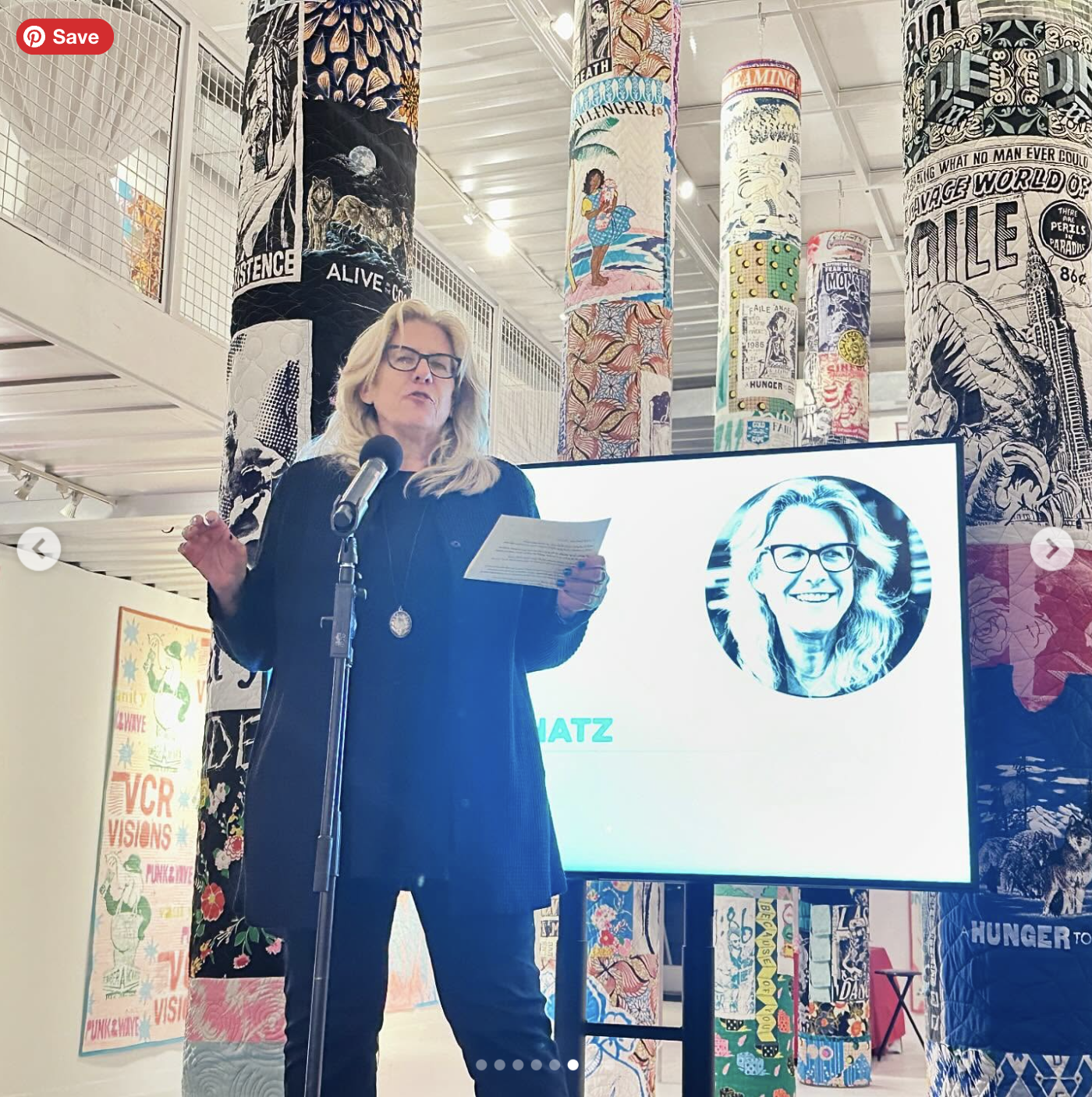
Diane Hatz

Originally uploaded by PURWaterFiltration

I got back from the TED Palm Springs conference last week.  (I know, I really should blog about it but it was sooo consuming…). We were given Sigg bottles in our gift bag and were told Pur would donate water to people in need if we put a message on the bottle and got our photo taken. This is where this photo came from.

A comment on Sigg – I threw mine out several months ago when I found out that up until the past year or so, Sigg was coating the inside of their water bottles with a coating that contained BPA (a neurotoxin). I was assured these were BPA-free, but I’m so not promoting Sigg anymore. Mason jars are a great way to go.

I’ll try to post something about what happened at TED over the weekend.

This post appeared on the CSRwire.com Talkback blog on January 29, 2010….

The Bible says, “Give a man a fish; you have fed him for today. Teach a man to fish; and you have fed him for a lifetime.” Sustainable food expert Diane Hatz takes that dictum to heart in her prescription for food security for Haiti after the earthquake.

Rebuilding Haiti’s Food System
by Diane Hatz

The earthquake that devastated Haiti on January 12th shocked the world. Immediate relief efforts must continue for as long as necessary and need to focus on providing food, shelter and medical care for the millions of Haitians affected. But, at the same time, experts must start looking at ways to rebuild the country, and a strong focus needs to be put on agriculture and the country’s food system.

The United Nation’s Food & Agriculture Organization (FAO) has called for $23 million for agriculture to support farms, backyard gardens, urban agriculture and rural development. And to be most effective, a sustainable system of agriculture needs to be introduced, where many farmers work small plots of land to yield many types of crops, and minimal to no pesticides or fertilizers are used.

In addition, the government needs to rebuild infrastructure such as roads and canals, provide subsidies for Haitian farmers, reforest destroyed land and increase tariffs on imported foods. Efforts must be made to help Haitians become self-sufficient so food riots like in April 2008 do not happen again.

This is vital to the rebuilding of Haiti. According to the United Nation’s World Food Programme, 76% of Haitians live on less than $2 day and 56% on less than $1 a day. The FAO reports that around 80% of Haitians are involved with agriculture, but they do not have the necessary expertise or equipment. Haitians need to be given the tools – training, seeds, hand tools, livestock such as pigs and chickens – in order to rebuild their food system.

In a developing country such as Haiti, expensive inputs such as chemical fertilizers, herbicides and pesticides need to be replaced with natural ways to grow food – compost, beneficial insects, crop rotation, diversified crops. These types of inputs are low to no cost and are more practical for the type of farming that needs to be done in the country. Because of the rugged mountainsides, large machinery is not feasible which saves on costs for parts and oil.

Haiti should look to its neighbor Cuba for inspiration. Before the fall of the Soviet Union, Cuba imported over 50% of its food and had an industrial-based agriculture system. After the Soviet Union disbanded in 1991, Cuba had nowhere to export and nowhere to get their pesticides, chemicals and industrial inputs from, so they were forced to create a sustainable food system.

Large farms were broken up into smaller plots and urban agriculture was introduced on a large scale. According to Food First, by 1999 sustainable urban agriculture produced 65% of Cuba’s rice, 46% of fresh vegetables, 38% of non-citrus fruits, 13% of roots, tubers and plantains, and 6% of eggs. Farmers and researchers from around the world now visit Cuba to learn more about their sustainable food system.

The planting season in Haiti is March, and the hurricane season begins in June. With so much effort now needed to provide emergency food relief and secure shelter for the upcoming storm season, there isn’t much focus on providing Haitians ways to produce their own food in the long term. But it is necessary. They need to plant as many crops as possible come March and also to look at how they can become a food secure country.

Diane Hatz is the Co-Founder & Director of The Glynwood Institute for Food and Farming, which focuses on solving critical problems with food and agriculture and will launch April 2010.

The Guide to Good Food blog series is coming along quite well – I already have interest from some publishers about turning it into a book and it’s being syndicated on a bunch of other blogs. Recent posts include Asking Questions (part 1 and part 2), Summer Days, Genetic Engineering and Buying Food. Check them out.

I’m also in the process of founding another program – it’s too soon to talk about it yet, but I can say that I’m no longer doing day-to-day Sustainable Table work, I’m working on a couple books, and I’m starting up a program that has the potential to be big big big…..

More soon!

So, I admit, I’ve been a little lazy about posting up on here….my Guide to Good Food blog series now has its own blog – called (what else?) but Guide to Good Food. Check it out at http://guidetogoodfood.wordpress.com.

If you want to keep up with the series, check it out there. The thought right now is to eventually turn it into a book. I’m working on one about The Meatrix right now, so we’ll see how long they both take….

At the TED conference this year, marketing guru Seth Godin gave a talk on Tribes. I was lucky enough to have gotten a scholarship to the conference so was sitting in the audience for his talk. I about fell out of my chair when he mentioned my name and a photo came up on the screen. I was sandwiched between The Beatles and Bob Marley – I was so honored!….

Click below to see Godin’s talk…..

Seth Godin on Tribes

(This is my post this week for the Guide to Good Food on The Daily Table, Sustainable Table’s blog.)

Farmers market fruitIn last week’s post, Sustainable vs. Industrial, we compared sustainable farming with industrial agriculture. This week, we have eight reasons why you should buy sustainable.

1. Tastes better. This is what convinced me to eat local sustainable and/or organic food. Many people believe that sustainable food simply tastes better – but you won’t know until you try it yourself, so might want to do your own taste test. Buy an organic or local sustainable apple and one of those large, waxed perfect-looking apples in the grocery store that come from a large industrial farm. Compare and let us know what you think!

2. Healthier. More and more health benefits are being found with sustainable food. Pasture-raised beef, for example, has two to six times more of the Omega-3 fatty acids needed for heart health and optimal brain function than grain-fed industrial meat. Eggs from pasture-raised chickens are not only higher in Omega-3 fatty acids, they’re also lower in cholesterol and calories. Organic fruits, vegetables and grains contain higher levels of nutrients, minerals, and antioxidants, including vitamin C, iron, magnesium and phosphorus.

3. Environment is protected. On a sustainable farm, animals graze on pasture and their manure fertilizes the fields. These sustainable farms only take from the land what they can put back, so the land and the environment are preserved for future generations. They do not pollute the surrounding soil, air and water with manure, chemical pollution or runoff.

(more…)

(This is today’s Guide to Good Food blog post from the Daily Table….)

hog-cafoIn the past two weeks, we’ve talked about sustainable and organic food, as well as industrial agriculture and factory farming in our Guide to Good Food. This week, we’re going to compare sustainable with industrial so you can see a side-by-side difference.

In general, the biggest differences between sustainable and industrial farms are the size of the operation (industrial farms are much bigger), the amount of pollution/effect on the environment (sustainable farms do not pollute the environment and they replace the resources they take), and the quality of food you get (small local sustainable farms provide fresher foods that not only taste better, they’re better for you).

To break it down and give you more specifics, I’ve done a comparison of the two types of farming so you can see how different these practices can be.

Health
Industrial farming: Industrial crops contain more nitrates and are often heavily sprayed with pesticides. Unsanitary conditions on factory farms and in industrial slaughterhouses cause high levels of meat contamination, which can cause food poisoning. In the U.S., food borne illness sickens 76 million people, causes 325,000 hospitalizations and kills approximately 5,000 people a year.

Sustainable farming: Food is grown with minimal or no use of pesticides or other dangerous chemicals. It can be healthier and more nutritious than industrially-raised food. Organic foods have been found to contain higher levels of antioxidants, which help fight certain types of cancer. Some types of organic crops contain more vitamin C, iron, magnesium and phosphorous.

Antibiotics and Hormones
Industrial farming: Low doses of antibiotics are given daily to animals to ward off illness and disease that can develop from unsanitary and overcrowded conditions. This contributes to problems with antibiotic-resistant bacteria in humans. Both antibiotics and hormones are used to make animals grow faster.

Sustainable farming: Antibiotics are only given if the animal is sick, and hormones are never given to the animals.

Environment
Industrial farming: Responsible for massive topsoil erosion, depletion and pollution of underground water supplies, and the reduction of genetic diversity. Industrial farms also pollute our air, surface water and soil with animal waste, hazardous gases, toxic chemicals and harmful pathogens.

Sustainable farming: Protects the natural environment, with farms managed in a responsible way, maintaining the fertility of the land and preserving resources for future generations. Sustainable farms use waste as fertilizer and don’t raise more animals than their land can handle.

(more…)

(This is the third in my blog series Sustainable Table’s Guide to Good Food that I’m posting up on the Daily Table blog.)

cows21Last week we talked about sustainable and organic, and the difference between the two. This week, we’re going to delve into the real issue – factory farming and industrial agriculture. The differences between sustainable and organic aren’t as big when you compare them to industrial food production.

Factory farming and industrial agriculture are unsustainable systems that produce large volumes of food but have little to no regard for the environment, animal welfare, soil and water quality, food safety, worker rights, farmers or local communities. The focus is on maximizing profit and efficiency – but at great cost.

The terms factory farming and industrial agriculture are used interchangeably, though factory farming is generally used to explain industrial animal production and industrial agriculture tends to describe or include intensive crop production.

What is a factory farm?

A factory farm is a large industrial operation that raises many animals (usually cows, pigs, chickens or turkeys) in overcrowded, confined conditions. Some animals are raised indoors in metal sheds, where they never see sunlight and often live on concrete slats, their feet never touching the earth. Other animals (cows mainly) are raised outdoors on large feedlots, huge tracts of barren land, where they stand in mud and their own feces, with no grass or trees nearby. These animals are not permitted to carry out their natural behaviors, like rooting, pecking and grazing.

(more…)

I’ve started a blog series on my work blog – the Daily Table.  You can read the first installment (explaining what I hope to do) here….

(This is the second installment of Diane Hatz’s series – Sustainable Table’s Guide to Good Food.)

Exactly what are sustainable farming and/or sustainable food, and what is organic agriculture?  Those are questions I hear quite often.  A general concept of organic has been seeping into the mainstream, but many people are still confused by both terms.  And to make it even more confusing, organic can be sustainable and sustainable can be organic, but they don’t have to be.  What?

To start with, sustainable farming is more of a concept or a philosophy than a literal definition.  With sustainable farming, food is raised that’s healthy for consumers, does not harm the environment, is humane for workers, respects animals, provides a fair wage to the farmer, and supports and enhances rural communities.  At Sustainable Table, we also believe that sustainable food should be grown as close to home as possible.

Yes, that is a bit of a mouthful – a shorter answer would be to say that sustainable farming provides food that’s healthy for consumers, farmers, the environment, animals, and local communities.

The challenge with sustainable is that there isn’t a government approved label or certification system, so you need to educate yourself and ask questions before you buy.  Also, there is no standard for what’s healthy for consumers or humane for workers.  There is no chart saying when the environment begins to be harmed, and so on.  That means that each of us has to learn as much as we can about the issues and decide what we think is best.  We’re not here to tell you what to do – we’re here to give you information, encouragement and perhaps advice; but it’s up to you to decide what you think is best for yourself.

Since 2002, organic food has been regulated by the government.  The United States Department of Agriculture (USDA) defines organic agriculture as “an ecological production management system that promotes and enhances biodiversity, biological cycles and soil biological activity.  It is based on minimal use of off-farm inputs and on management practices that restore, maintain and enhance ecological harmony.”

Another mouthful.  To put it more simply, with organic farming
•    most synthetic (and petroleum derived) pesticides and fertilizers are prohibited;
•    all antibiotics, genetic engineering, irradiation and sewage sludge are prohibited;
•    all organically produced animals must have access to outdoors and be fed organic feed; and
•    all processed products labeled organic must have 95% organic ingredients.

They look rather similar, don’t they?  But there are differences….  Let’s do a comparison.

(more…)

Next Page »